

How much is a reasonable cost for liposuction? An analysis of the prices, effects, and risks of VASER, LSSA, and traditional liposuction.
Table of Contents
- Liposuction Cost Unveiled: Why is There Such a Big Price Gap?
- 2026 Mainstream Liposuction Technology Comparison: How to Choose Between VASER, LSSA, and Traditional Liposuction?
- Liposuction recovery timeline: Physiological changes from day 1 to day 30
- Liposuction Safety and Risk Prevention: How to Avoid Uneven Skin Texture?
- Common Questions about Liposuction (FAQ)
Liposuction Cost Unveiled: Why Is There Such a Big Price Gap?
When consulting about liposuction surgery, the most common question is "How much does liposuction cost?" In fact, the cost of liposuction is not a fixed price, but is assessed based on multiple variables. Generally speaking, the cost for a single area (such as the arms or inner thighs) is approximately NT$60,000 to NT$100,000, while large area liposuction (such as abdominal liposuction or thigh liposuction) may fall within NT$150,000 to NT$250,000。
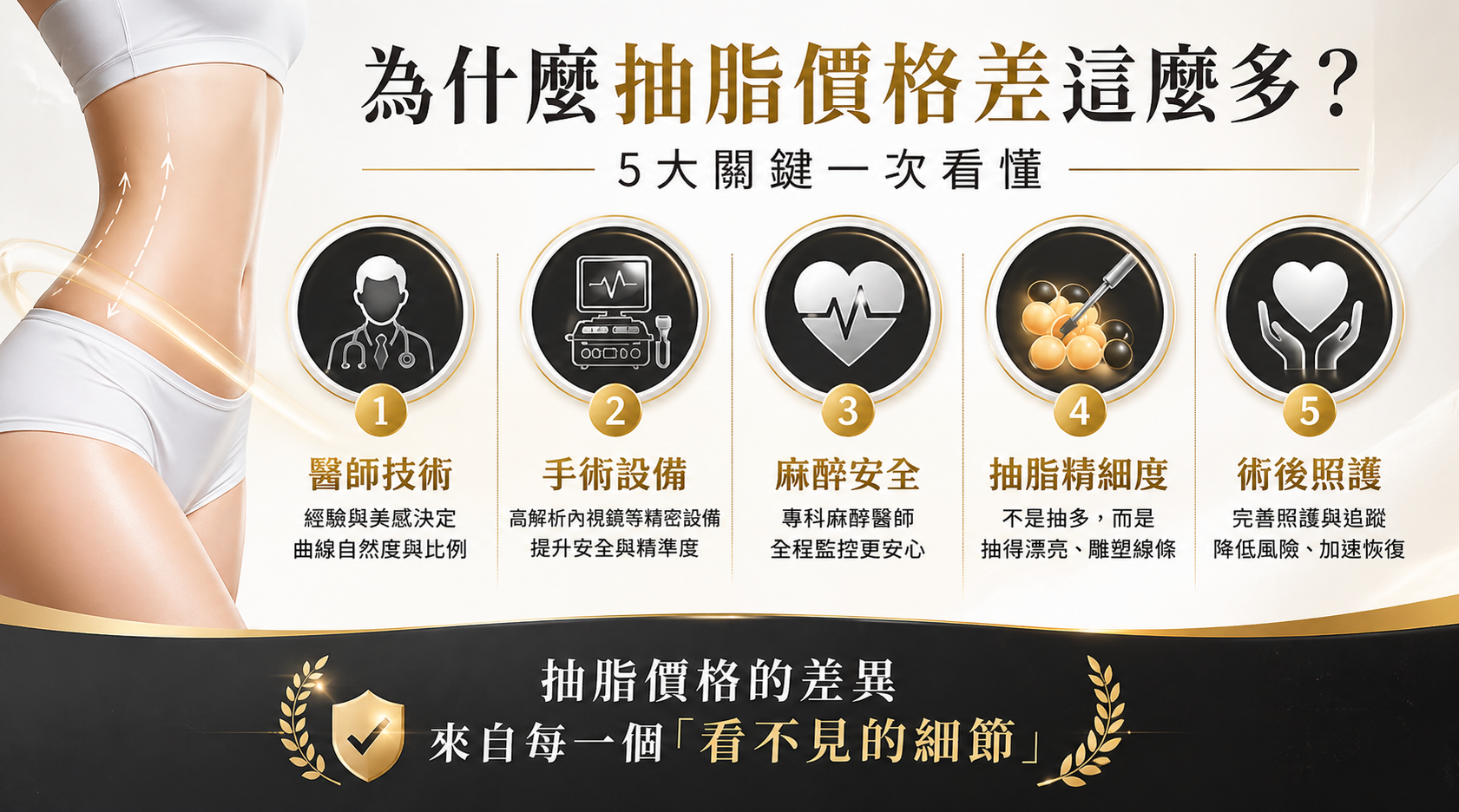
The main reasons for the differences in liposuction costs include the following four key factors:
1.Selection of liposuction equipment and techniques
Different liposuction devices have vastly different equipment costs and technical thresholds. For example, traditional liposuction mainly relies on the physician's manual strength for physical disruption and extraction, resulting in lower equipment costs, and thus the price is usually the most affordable. In contrast, VASER liposuction ( VASERUtilizing patented ultrasonic technology to emulsify fat can significantly reduce damage to blood vessels and nerves, and it has the characteristics of deep suction and superficial sculpting. The equipment is expensive and requires the physician to have original factory certification, so the costs are relatively high.
2.The range and difficulty of liposuction areas
The calculation of liposuction costs is usually closely related to the "area" and "amount of fat". For small areas such as the arms, axillary fat, or double chin, the surgery time is shorter, and the cost is naturally lower; while for abdominal liposuction (including upper abdomen, lower abdomen, side waist, and lower back) or thigh liposuction (including front, back, inner, and outer thigh), due to the larger area and greater amount of fat, as well as the need to ensure overall symmetry and smoothness, the difficulty and time of the surgery will increase significantly, and the costs will rise accordingly.
3.The involvement of anesthesiologists
The safety of liposuction surgery is critically influenced by anesthesia. A legitimate plastic surgery clinic will definitely hire a "Ministry of Health and Welfare certified anesthesiologist" to monitor the patient's vital signs throughout the procedure. Although this anesthesia fee increases the overall surgical cost, it is an indispensable safeguard for the patient's life safety. Some low-priced promotional clinics may skip this step and have nursing staff or non-specialist doctors administer anesthesia, which undoubtedly significantly increases the surgical risk.
4.Post-operative care and material costs
The complete cost of liposuction usually includes postoperative compression garments, anti-swelling IV drips, sterile supplies, and postoperative follow-up services such as dressing changes and suture removal. The compression garment has a decisive impact on postoperative hemostasis, reducing swelling, and helping the skin adhere to the tissue, and its material and design will also be reflected in the cost.
2026 Mainstream liposuction technology comparison: VASER,LSSA How to choose traditional liposuction?
The common liposuction techniques in the Taiwanese market currently include traditional liposuction, water jet liposuction, and VASER liposuction.VASERand the emerging in recent yearsLSSASound wave liposuction. Each technique has its principles and applicable subjects, below is a detailed comparison for you.
|
Comparison items |
VASER liposuction(VASER) |
LSSAsound wave liposuction |
Traditional liposuction |
|
Principle of operation |
Patent titanium metal probe release 36,000 Hertz ultrasound generates the "cavitation effect" to emulsify fat lumps into a liquid state before extraction. |
Using ultrasonic energy to dissolve fat, the probe is extremely thin (minimum only 0.9mm)。 |
After injecting the expansion fluid, fat is scraped away using a negative pressure machine and a metal tube, through a physical back-and-forth motion. |
|
Bleeding volume and destructive power |
Low. It can selectively destroy fat cells while greatly preserving surrounding nerves, blood vessels, and connective tissue. |
Low. The ultra-fine probe is suitable for delicate areas and has low destructive power. |
High. Physical scraping easily damages surrounding blood vessels and nerves, resulting in more noticeable bruising and swelling after surgery. |
|
Skin tightening effect |
Ultrasound thermal energy can stimulate collagen production, promoting skin contraction and tightening, suitable for those with loose skin. |
Good. It also has a thermal tightening effect. |
Poor. Simply removing fat can lead to wrinkles or unevenness after surgery if the skin was originally loose. |
|
Fat survival rate(若需回填) |
High. The emulsification process is gentle, and the integrity of the extracted fat cells is high, making it suitable for autologous fat breast augmentation or facial filling. |
The extracted fat cells are fine and have a good survival rate. |
Low physical damage easily causes fat cell rupture, resulting in a poorer survival rate for the fillers. |
|
Suitable areas and candidates |
All parts of the body. Especially suitable for large area liposuction, secondary liposuction repair, and patients needing "shallow fat sculpting" (such as abdominal lines and six-pack abs). |
Fine sculpting of small areas such as the face (e.g., double chin, jowls), arms, and bra bulge. |
Those with a limited budget who only need to undergo localized deep fat extraction and have good skin elasticity. |
|
Recovery period |
Shorter. About 1-2 weeks to resume daily activities. |
Shorter. Due to the extremely small incision, there is almost no recovery period. |
Longer。About 2-4 weeks.Swelling and bruising can gradually subside over the weeks. |
Doctor's professional advice:
At Enherya, we highly recommend adoptingVASER liposuction(VASER)VASER not only effectively removes deep fat, but its unique superficial fat sculpting function is also a powerful tool for creating muscle lines such as the abdominal line and mermaid line. More importantly, VASER can significantly reduce blood loss, enhance surgical safety, and promote skin tightening through thermal energy, effectively avoiding the embarrassment of post-operative skin laxity and sagging.
Liposuction recovery timeline: Days 1 through 30 Physiological changes of the day
Many patients are concerned about the recovery period after liposuction. Understanding the physiological changes at each stage post-surgery can effectively reduce anxiety, and with the correct care methods, recovery can be accelerated.
Days 1 through 3: Swelling and Exudation PhaseSwellHell)
- Physiological changes:This is the most uncomfortable stage after surgery. The liposuction areas will feel significant swelling, soreness, and tightness, similar to severe muscle soreness after intense exercise. There may be blood-tinged tissue fluid oozing from the wound, which is the expulsion of the injected expansion fluid and is considered a normal phenomenon.
- Care Focus:
- 24 Hours wearing shapewear as a child:Shapewear can provide compression to stop bleeding, reduce swelling, and help the skin adhere. It should be worn all day except when bathing.
- Take medication on time:Take anti-inflammatory painkillers and antibiotics as directed by the doctor.
- Rest more and move around moderately:Avoid intense exercise, but light indoor walking is allowed to promote blood circulation and prevent deep vein thrombosis.。
Days 4 through 7: Bruising appears and swelling gradually subsides
- Physiological changes:Serous fluid usually after surgery2-3Within a few days, the bruising in the liposuction area will become noticeably apparent, with colors possibly changing from purplish-red to yellow-green. The swelling will gradually subside, and the pain will also turn into mild tenderness.
- Care Focus:
- Warm compress:Post-operative4In the morning, you can start applying warm compresses to the bruised areas to promote local blood circulation and accelerate the fading of the bruises.
- Lymphatic massage:It is recommended to start gentle lymphatic drainage massage under the guidance of a professional, which helps to eliminate excess water and metabolic waste from the body, reducing swelling.
Weeks 2 through 3: Tissue Repair and Lump Phase
- Physiological changes:Most of the bruising has subsided. At this time, the subcutaneous tissue is undergoing repair and reconstruction. There may be some lumps that can be felt in the liposuction area or localized numbness and tingling sensations, which is a normal process of nerve regeneration.
- Care Focus:
- Strengthening massage:You can increase the strength and frequency of the massage, using your fingertips or the base of your palm to apply circular pressure on the hard lumps, helping to disperse the lumps, prevent scar tissue adhesion, and allow the skin to return to a smooth and soft condition.
- Resuming daily activities:Most patients can resume office work and light exercise (such as brisk walking and yoga) at this stage, but should still avoid heavy lifting or intense aerobic exercise.
Months 1 through 3: Golden Shaping Period and Final Effect Display
- Physiological changes:Swelling and lumps almost completely disappear, and the skin gradually regains elasticity and firmness. The body's curves and contours become more pronounced, and the final liposuction results are typically seen after the surgery.3Completely stable after a month.
- Care Focus:
- Adjusting the wearing time of shapewear:One month after the surgery, the wearing time of the shaping garment can be changed to every day.8-12hours (such as wearing only during the day or while sleeping), continue to wear it fully3months, to maintain optimal shaping results.
- Maintain a healthy lifestyle:Although liposuction removes fat cells, if diet is not controlled, the remaining fat cells will still expand and grow larger. Maintaining a balanced diet and regular exercise is the only way to sustain the effects of liposuction.
Liposuction Safety and Risk Prevention: How to Avoid Uneven Skin Texture?
Overall, liposuction surgery is safe. According to medical statistics, the incidence of serious complications is extremely low (approximately 0.25%)However, any surgery carries risks, and understanding and preventing these risks is essential for patients to do before the procedure.
Common Risks 1 uneven skin texture
This is one of the most concerning side effects for patients. The main reasons are usually uneven fat extraction by the physician, excessive extraction of superficial fat, or failure to wear compression garments and perform massages post-surgery.
- Prevention strategies:Choose an experienced plastic surgeon and pair them with advanced equipment such as VASER that can evenly emulsify fat. After the surgery, be sure to follow the doctor's advice, wear the compression garment, and massage frequently.
Common Risks 2 Anesthesia safety issues
Liposuction surgery usually uses sedation anesthesia or general anesthesia. If the anesthesia assessment is inadequate or intraoperative monitoring is improper, it may lead to serious consequences such as respiratory depression.
- Prevention Strategies:Ensure that the clinic is equipped with a "Ministry of Health and Welfare certified anesthesiologist" on-site throughout the procedure, and has comprehensive emergency equipment (such as physiological monitors and ambulances).
Common Risks 3 fat embolism
This is the rarest but also the most deadly complication of liposuction surgery. When fat particles accidentally enter a ruptured blood vessel and block circulation in the lungs, it can trigger acute pulmonary embolism.
- Prevention strategies:The physician's skill and experience are key. Using VASER liposuction can significantly reduce vascular damage, thereby lowering the risk of fat embolism. In addition, it is advisable to avoid performing large-scale and high-volume liposuction in one session (generally recommended not to exceed the amount of fat removed in a single session).3000-5000cc), which is also an important principle for ensuring safety.
Common Questions about Liposuction (FAQ)
Can liposuction help with weight loss? How much lighter will I be after the procedure?
The purpose of liposuction is to "sculpt the body" rather than "reduce weight." The density of fat is very low (lighter than water), so removing 3000 cc of fat may only result in a weight loss of 1-2 kilograms, but the visual changes in body shape (such as a smaller waist and thinner thighs) will be very noticeable.
Will I regain weight if I don't exercise after liposuction?
The number of fat cells in adults is fixed, and liposuction directly reduces the number of fat cells in the treated area. Therefore, the likelihood of regaining weight in the liposuction area is extremely low. However, if one engages in long-term overeating after the procedure, the remaining fat cells in the body will still increase in size, leading to an overall increase in fat volume. Thus, maintaining a healthy diet and exercise habits is still necessary.
Is there a difference in incision size between VASER liposuction and traditional liposuction? Will there be scarring?
Regardless of the liposuction technique used, the incision size is typically around 0.5 centimeters. A professional plastic surgeon will hide the incision in the natural folds of the skin (such as inside the navel, groin, or underarm), and after the wound heals and fades over time, the scar is almost negligible.
Can the extracted fat be repurposed?
Of course! This is known as 'autologous fat transfer.' The extracted fat can be purified and then used to enhance the breasts (autologous fat breast augmentation), face (cheek enhancement, filling in nasolabial folds), or buttocks, achieving a twofold benefit. Especially when using VASER liposuction, the low destruction rate of fat cells results in a relatively higher survival rate for the transferred fat.